
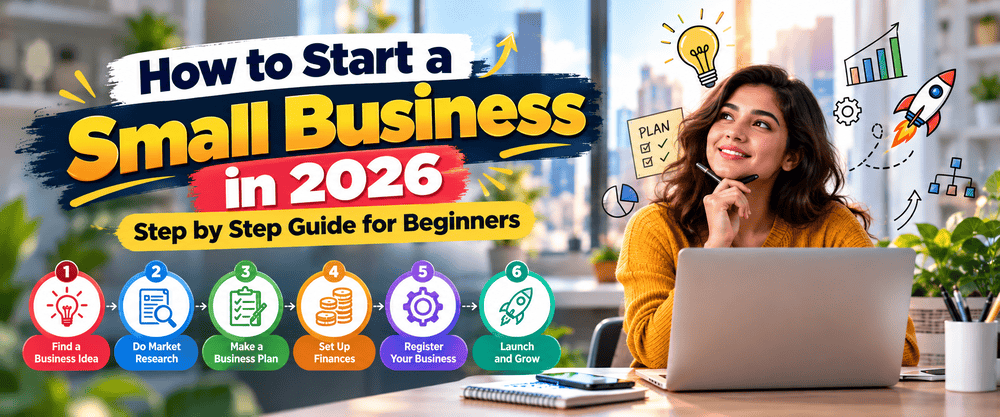
Starting a small business is one of the most exciting and terrifying things a person can do.
I have been advising small and medium businesses for over a decade and the single biggest mistake I see aspiring entrepreneurs make is not starting at all. They wait for the perfect idea, the perfect timing, the perfect amount of savings. They research endlessly, plan obsessively and then find another reason to wait a little longer.
The truth is there is no perfect moment to start a business. There is only now.
This guide is for anyone who has an idea, a skill or a passion and wants to turn it into a real business. Whether you are in India, the UK or anywhere else in the world the fundamental steps are the same. I am going to walk you through exactly how to start a small business in 2026 from validating your idea to making your first sale in plain language with no unnecessary jargon.
Finding and Validating Your Business Idea
Before you spend a single rupee or pound on your business you need to validate that people actually want what you are planning to offer. This is the step most aspiring entrepreneurs skip and it is the reason most small businesses fail within the first two years.
Identify a real problem you can solve
The best businesses do not start with a product or service. They start with a problem. Think about the problems you encounter regularly in your own life or in your professional experience. Think about the complaints you hear from people around you. Think about the things that frustrate you about existing products and services in your industry.
Every successful business is fundamentally a solution to a problem that enough people have and are willing to pay to solve. The more painful the problem and the fewer good solutions that currently exist, the more opportunity there is for a new business.
Ask yourself these questions honestly. What problem am I solving? Who has this problem? How much does this problem cost them in time, money or frustration? Would they pay to have it solved?
Research your target market thoroughly
Once you have identified a problem you want to solve you need to understand the people who have that problem. This is your target market and the more specifically you can define them the better your chances of success.
Good market research does not require expensive consultants or elaborate surveys. Talk to 20 people who match your target customer profile. Ask them about the problem you are solving. Find out how they currently deal with it. Ask what they would pay for a better solution. Read reviews of existing competitors particularly the negative ones. Spend time in online communities and forums where your target customers discuss their challenges.
This research will tell you whether your idea is genuinely viable, who your real competitors are, what your potential customers actually value and how to position your business effectively.
Validate demand before investing money
Validation means confirming that real people will actually pay real money for your product or service before you invest significant time and money building it.
The simplest validation method is pre-selling. Can you find five people willing to pay you in advance for what you are planning to offer? If you can that is your most powerful possible signal that the business is viable. If you cannot, that is critical information you need before investing further.
Other validation methods include creating a simple landing page describing your product and measuring how many people sign up for more information, running a small paid advertising test to see if people click through, or offering a small-scale version of your service to a handful of customers at a discounted rate in exchange for feedback.
Analyse your competition honestly
Having competitors is not a bad thing. It confirms that the market exists. What matters is whether you can offer something meaningfully different or better.
Study your top three to five competitors carefully. What do they do well? What are their customers complaining about in reviews? What is missing from their offering? Where do they fall short? The gaps you identify in competitor offerings are your opportunity to build something genuinely better.
Planning Your Business
Write a simple one page business plan
You do not need a 50 page document to start a small business. You need a clear, simple plan that forces you to think through the fundamentals. A one page business plan should cover your business idea and the problem it solves, your target customer, your competitors and how you are different, your pricing model, your sales and marketing approach and your basic financial projections for the first year.
The discipline of writing this down even on a single page forces clarity of thinking that is worth more than any amount of additional research.
Define your product or service with precision
Exactly what are you selling? To whom? At what price? What is included and what is not? What does the customer experience look like from the moment they first hear about you to the moment they receive what they paid for?
The more precisely you can answer these questions before you launch the smoother your operations will be. Ambiguity in your product definition leads to customer confusion, scope creep and disputes over what was agreed.
Set realistic financial projections
How much will it cost to start your business? How much revenue do you need to cover your costs? How long will it take to become profitable? What is your break even point?
These are not questions to guess at. Work through the numbers carefully. List every cost you can anticipate — registration fees, equipment, marketing, software, insurance, office space if needed. Then calculate how many sales at your planned price point you need to cover those costs. If the numbers do not add up at your proposed price you need to either reduce costs or increase prices before you launch.
Choose the right business structure
In India your main options are sole proprietorship, partnership, Limited Liability Partnership or Private Limited Company. Each has different implications for taxation, liability and administrative requirements.
For most small businesses starting out a sole proprietorship or one person company is the simplest and most cost effective structure. As your business grows and your revenue and risk increase you can restructure into a more formal entity. Consult a chartered accountant for specific advice on the best structure for your particular situation.
Setting Up Your Business
Register your business legally
Business registration requirements vary by country and business structure but the principle is the same everywhere operating an unregistered business exposes you to legal risk and limits your ability to open business bank accounts, sign contracts and build credibility with customers.
In India the Ministry of Corporate Affairs portal makes company registration straightforward for most business types. You will need a PAN card, an Aadhaar card and basic business details. A chartered accountant or company secretary can handle the entire process for a modest fee if you prefer not to navigate it yourself.
Open a dedicated business bank account
This is non-negotiable. Mixing personal and business finances is one of the most common and most damaging mistakes small business owners make. It makes tax reporting enormously complicated, makes it impossible to get a clear picture of your business finances and can create serious legal issues in some circumstances.
Open a separate business current account the day you register your business. Use it exclusively for business income and expenses from day one.
Set up a simple accounting system
You do not need elaborate accounting software to start. A simple spreadsheet tracking all income and expenses by category is sufficient in the early days. As your transaction volume grows consider free or low-cost accounting software like Wave Accounting or the basic tier of Zoho Books which is free for Indian businesses up to a certain revenue threshold.
Keep every invoice and receipt. Record every transaction when it happens not at the end of the month. Know your numbers at all times.
Build your online presence
In 2026 an online presence is not optional for any business. At minimum you need a professional website that clearly explains what you offer, who it is for and how to contact you. You need a Google My Business profile so you appear in local search results. And you need a presence on the social media platforms where your target customers spend their time.
Your website does not need to be elaborate or expensive. A clean, well-written three to five page website built on WordPress or Wix communicates professionalism and gives potential customers the confidence to contact you.
Register for GST if applicable
In India businesses with an annual turnover above Rs 20 lakhs are required to register for GST. Even if you are below this threshold voluntary GST registration can be beneficial as it allows you to issue GST invoices and claim input tax credits. Consult your chartered accountant about whether and when GST registration makes sense for your business.
Marketing Your Small Business
Getting your first customers is the hardest part of starting a business. These small business marketing tips have helped the businesses I work with generate their first sales without large marketing budgets.
Define your ideal customer with uncomfortable specificity
The more specifically you can define your ideal customer the more effectively you can reach them. Not small business owners but female small business owners aged 30 to 45 in Mumbai running service businesses with annual revenue between 20 and 50 lakhs who are struggling to find reliable staff. The more specific your definition the more precisely you can target your marketing.
Start with your existing network
Your first customers are almost always people you already know or people who know people you know. Before spending any money on advertising tell everyone in your personal and professional network what you are doing. Post about it on LinkedIn. Tell former colleagues and classmates. Ask family friends if they know anyone who might need what you offer.
This is not a long-term marketing strategy but it is often enough to generate the first few clients or customers who can then provide testimonials, referrals and the cash flow to fund further marketing.
Use content marketing and SEO
Creating genuinely useful content around the topics your potential customers are searching for online is one of the most cost effective small business marketing tips available. A blog post that answers a question your customers frequently ask can bring visitors to your website for years from a single investment of time.
Combine this with the basic SEO principles covered in our earlier article proper title tags, meta descriptions, keyword research and internal linking and you have a sustainable long-term strategy for attracting organic traffic without ongoing advertising spend.
Ask every happy customer for a referral
Word of mouth is the most powerful and least expensive form of marketing available to a small business. But most small business owners wait for referrals to happen naturally rather than actively asking for them.
After every positive customer experience ask directly and specifically. Do you know anyone else who might benefit from what I helped you with? Would you be willing to introduce me? A warm referral from a satisfied customer converts at a dramatically higher rate than any other form of marketing.
Build your Google My Business profile properly
For any business serving a local market a fully optimised Google My Business profile is one of the highest return on investment marketing activities available. It is completely free, it appears prominently in local search results and it allows customers to leave reviews that build your credibility.
Fill in every field completely. Add photos of your business, your team and your work. Respond to every review positive and negative. Post updates regularly. The more complete and active your profile the higher it will appear in local search results.
Growing Your Business
Track your key business metrics every week
You cannot improve what you do not measure. Every small business should track a small number of key metrics weekly at minimum. How many new leads did you receive? How many converted into customers? What was your average transaction value? What is your monthly recurring revenue? What is your customer acquisition cost?
These numbers tell you the health of your business with far more accuracy than your intuition alone. When the numbers move in the wrong direction you can identify the problem and address it quickly. When they move in the right direction you can identify what is working and do more of it.
Focus obsessively on customer retention
Acquiring a new customer costs five to seven times more than retaining an existing one. Yet most small businesses spend the majority of their marketing budget chasing new customers while neglecting the ones they already have.
Stay in regular contact with existing customers. Deliver consistently excellent service. Ask for feedback and act on it. Create loyalty programmes or incentives for repeat business. Offer existing customers early access to new products or services. A customer who buys from you twice is dramatically more likely to become a long-term loyal customer than one who has only bought once.
Reinvest your profits into growth
The temptation when a small business starts generating profit is to take as much as possible as personal income. Resist this temptation in the early years. Reinvesting profits into better marketing, better systems, better staff and better products compounds your growth far faster than taking the money out.
A useful rule of thumb in the early years is to reinvest at least 50% of profits back into the business. Adjust this as your business matures and your personal financial situation allows.
Build systems before you need them
The businesses that scale successfully are the ones that build systems and processes early when there is still time to do it thoughtfully. Document how you deliver your service, how you handle customer enquiries, how you manage invoicing and payments, how you onboard new customers.
Systems allow you to delegate work to team members without quality suffering, identify inefficiencies that cost you time and money and scale operations without everything depending on you personally.
Common Mistakes First Time Business Owners Make
After a decade of advising small businesses I have seen the same mistakes made repeatedly. Here are the ones that most often lead to early failure.
Spending money before validating the idea. Investing in expensive branding, a custom website or equipment before confirming that customers will pay for your product is one of the most common and most costly mistakes.
Pricing too low. New business owners consistently undercharge because they are afraid of losing customers. Underpricing attracts low-quality customers, creates an unsustainable business model and makes it very hard to raise prices later.
Ignoring marketing until it is too late. Many new business owners focus exclusively on delivering their service and assume customers will find them. They will not. Marketing is not something you do after you have built the business. It is something you do from day one.
Trying to do everything alone. The most successful small business owners I work with know what they are good at and delegate or outsource everything else as soon as they can afford to. Trying to be your own accountant, website designer, social media manager and service delivery person simultaneously is a recipe for burnout and mediocrity across all of them.
Conclusion
Starting a small business is not easy. Anyone who tells you otherwise is either lying or has forgotten what the early days actually feel like.
But it is absolutely achievable. Hundreds of thousands of new businesses launch successfully every year. The ones that succeed are not necessarily the ones with the best ideas or the most money. They are the ones with the discipline to validate before investing, the resilience to learn from early setbacks and the consistency to keep showing up even when progress feels slow.
Use this guide as your starting point. Work through each step in order. Do not skip the validation stage. Know your numbers from day one. And remember that every large successful business you admire today was once exactly where you are now — a single person with an idea and the courage to begin.
The best time to start was yesterday. The second best time is today.