
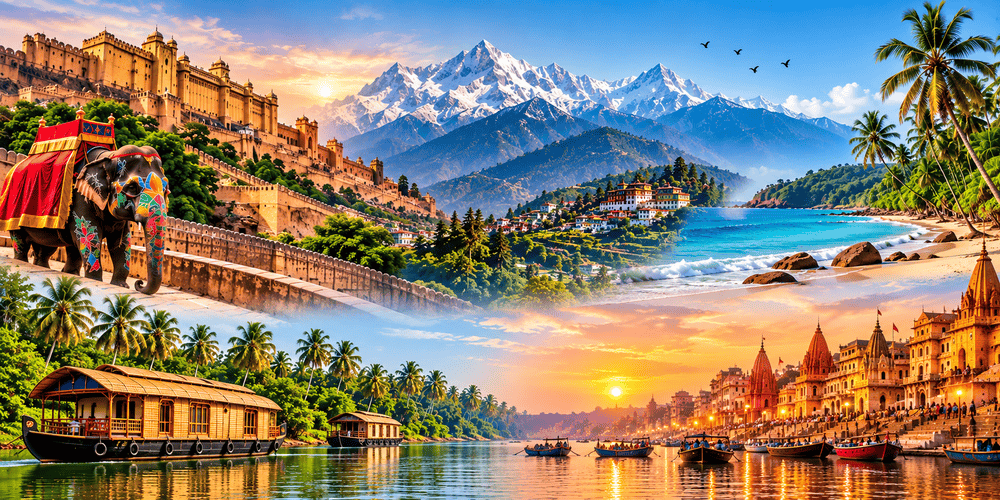
India is not a place you simply visit. It gets under your skin, and it stays there.
I have been to more than 40 countries on six continents. None of them hit me the way India did. The size, the noise, the colour, the food: it is a lot, and I mean that in the best way. On one trip you can wake up near the Himalayas, fly south for a seafood dinner on a Goan beach, and later sleep in an old palace in Rajasthan. Few countries pack that much variety into one map.
Maybe this is your first trip and you have no idea where to start. Maybe you’ve been before and want something new. Either way, this guide covers 25 places worth your time in 2026. Some are famous. Some are not. All of them are worth it.
North India for History, Faith and Mountains
Most first-timers start in the north, and that makes sense. You get famous monuments, holy cities and mountain towns, all within a few hours of each other.
1. Taj Mahal, Agra (Uttar Pradesh)
You can’t write about India without starting here. Photos don’t prepare you for it. Emperor Shah Jahan built it for his wife, Mumtaz Mahal, and the work took about 20 years and some 20,000 workers. Go at sunrise. As the sun comes up, the marble shifts from white to gold to a soft pink. That’s when it all makes sense.
When to go: October to March
My tip: Buy your tickets online ahead of time. The lines at the gate can be brutal.
2. Jaipur, Rajasthan (The Pink City)
Jaipur’s old city is painted a warm, dusty pink. The story goes that it was painted in 1876 to welcome the Prince of Wales, and the colour stuck. Amber Fort, City Palace, Hawa Mahal and the Jantar Mantar observatory are all close together, so you can see a lot in a short time. Then there are the markets. Think block-printed cloth, blue pottery, gems and silver.
When to go: October to February
My tip: Hire a local guide at Amber Fort. Without one, you’ll walk past half the stories.
3. Varanasi, Uttar Pradesh
Nothing I’ve seen compares to Varanasi. People have lived here for thousands of years, and it has been a holy city for Hindus for over 3,000 of them. Every evening, priests on the riverbank hold the Ganga Aarti. They wave fire and incense while small lamps drift down the Ganges. I stood there with a crowd of strangers and nobody spoke. Varanasi is crowded and hard work. It is also a place you will never forget.
When to go: October to March
My tip: Take a boat out at dawn. Seeing the ghats from the water as the city wakes up is something special.
4. Amritsar, Punjab (The Golden Temple)
The Golden Temple, or Harmandir Sahib, is the holiest place in the Sikh faith. It is covered in real gold and sits in the middle of a sacred pool. Anyone can visit, whatever their religion, and about 100,000 people do every day. Don’t skip the langar. It’s a free kitchen that serves a hot meal to everyone who walks in, around 50,000 people a day. Sitting on the floor and eating with everyone else is a humbling thing.
When to go: October to March
My tip: Come back after dark. The lit-up temple glowing in the water is stunning.
5. Rishikesh, Uttarakhand
Rishikesh sits where the Ganges leaves the mountains and flows onto the plains. It’s known around the world as India’s yoga capital. The Beatles came here in 1968 to study with Maharishi Mahesh Yogi, and seekers have followed ever since. But it’s not all quiet and calm. You can also go white water rafting, bungee jumping, camping and trekking.
When to go: September to June
My tip: Watch the sunset Aarti at Triveni Ghat. It’s smaller than the one in Varanasi but just as moving.
South India for Temples, Backwaters and Green Hills
The south feels like a different country. It’s greener, warmer and slower. The culture here is ancient and Dravidian, and a lot of repeat visitors say it’s their favourite part of India.
6. Kerala Backwaters
Kerala’s backwaters are a web of lakes, rivers, lagoons and canals running along roughly 900 kilometres of coast. The best way to see them is from a houseboat. You float past palm trees and tiny villages while a cook on board makes you fish curry from the day’s catch. It’s one of the most relaxing things I’ve done anywhere in Asia.
When to go: November to February
My tip: Book your houseboat in Alleppey instead of Kumarakom. It feels more local and less packaged.
7. Mysore, Karnataka
Mysore is calm, tidy and full of history. The Mysore Palace is one of the most visited sites in India. On Sunday evenings it lights up with close to 100,000 bulbs, and the whole place glows. Don’t miss Devaraja Market either. It is packed with flowers, spices, silk and sandalwood, and it smells amazing.
When to go: October to February
My tip: Plan your trip around Dasara in October. The city throws a party that lasts ten days.
8. Hampi, Karnataka
Hampi is one of India’s best sights, yet most tourists never make it here. It was once the capital of the Vijayanagara Empire, among the richest cities of its time. Today its ruins are spread across a strange, beautiful landscape of huge boulders, banana farms and rice fields. Rent a bike and ride between the temples as the sun goes down. The stone turns gold, and you’ll feel like you’ve found a secret.
When to go: October to February
My tip: Give it at least two nights. One day barely scratches the surface.
9. Ooty, Tamil Nadu
Ooty sits 2,240 metres up in the Nilgiri Hills. The British used it to escape the summer heat, and it still has an old-world feel. The best part is getting there. The little toy train from Mettupalayam winds up through the hills, and it’s one of the prettiest train rides in the country. The line is part of a UNESCO World Heritage Site.
When to go: April to June, or September to November
My tip: Book the Nilgiri Mountain Railway early. Seats sell out fast.
10. Coorg, Karnataka
Coorg is all rolling hills, coffee farms, cardamom, thick forest and waterfalls. The air really does smell of coffee. The people here are warm and welcoming, and the food is a highlight. Try the pork curry with rice. You won’t regret it.
When to go: October to March
My tip: Skip the hotels and stay with a family on a coffee estate. You’ll eat better and learn more.
The Best Hill Stations
The British built most of these towns as places to hide from the summer heat. They’re still lovely today, and many are worth visiting in any season.
1. Shimla, Himachal Pradesh
Shimla was once the summer capital of British India. It’s still one of the busiest hill towns in the country. People come for the Mall Road, the old colonial buildings, Christ Church and the mountain views. In winter, heavy snow turns the whole town white.
When to go: March to June for mild weather, December to February for snow
2. Manali, Himachal Pradesh
Manali sits at 2,050 metres at the top of the Kullu Valley. It’s the starting point for trips to the high passes of Rohtang and Spiti. If you like adventure, this is your town. You can trek, ski, paraglide, raft or mountain bike.
When to go: October to June
3. Darjeeling, West Bengal
Darjeeling is famous for its tea. It’s also famous for one view. On a clear morning, head up to Tiger Hill and watch Kangchenjunga, the third highest mountain on Earth, rise above the clouds. It’s a sight you’ll talk about for years. Like Ooty, Darjeeling has a UNESCO-listed toy train that chugs up through the tea gardens.
When to go: March to May, or September to November
4. Mussoorie, Uttarakhand
Mussoorie is about 290 kilometres from Delhi, which makes it the easiest hill town to reach from the capital. It’s a favourite weekend getaway. Kempty Falls, Gun Hill and the Mall Road are the main sights. Really, though, you come for the cool air and the views over the Doon Valley.
When to go: April to June
5. Munnar, Kerala
Munnar sits at 1,600 metres in the Western Ghats. Tea bushes cover more than 30,000 hectares of hills around it, and they stretch as far as you can see. It’s green, cool and often misty. Nowhere else in India looks quite like it.
When to go: September to March
Beaches
India has more than 7,500 kilometres of coastline. Some of Asia’s best beaches are here.
6. Goa
Most people have heard of Goa. Its coast runs about 105 kilometres. The north is lively, while the south is calmer. But Goa is more than sand. Walk through the old Portuguese churches of Old Goa, visit a spice farm, try cashew feni, and eat as much as you can. The food alone is worth the trip.
When to go: November to February
7. Andaman Islands
These islands sit out in the Bay of Bengal. The diving and snorkelling here are world class. Radhanagar Beach on Havelock Island has been named one of the best beaches in Asia. The water is warm, clear and so blue it barely looks real.
When to go: November to April
8. Varkala, Kerala
Varkala is different from most beaches in Kerala. Tall red cliffs drop straight into the sea, and the top is lined with cafes facing the Arabian Sea. It’s quieter than Goa, less built up, and in my view, prettier.
When to go: November to March
9. Puri, Odisha
Puri mixes a holy city with a long, wide beach. The Jagannath Temple is one of the four holiest places in Hinduism. Each year, the Rath Yatra festival pulls huge chariots through the streets, and over a million pilgrims come to watch.
When to go: October to February
10. Tarkarli, Maharashtra
Few people outside India know about Tarkarli. It’s a clean, quiet beach at the southern tip of Maharashtra. The water is clear, the snorkelling is good, and you’ll see only a fraction of the crowds you’d find in better-known spots.
When to go: October to March
Where to Go in Winter
For most of India, November to February is the best time to travel. The weather is mild almost everywhere. These places are at their best in the cooler months.
1. Rajasthan
In winter, the whole state wakes up. The cool days are perfect for walking around the forts and palaces of Jaipur, Jodhpur and Udaipur. If you’re there in November, don’t miss the Pushkar Camel Fair. It’s one of the wildest, most colourful events in the country.
2. Kerala
Winter is peak season in Kerala, and it’s easy to see why. The rains are over, everything is lush and green, and the heat has eased. It’s the ideal time for a backwater trip.
3. Goa
This is Goa at its best. The sun is out, the sea is calm, and there’s something happening almost every week. Christmas and New Year here are famous around the world, so book early if you want to be there.
4. Rann of Kutch, Gujarat
The Great Rann of Kutch is one of the biggest salt deserts on the planet. Each winter, the Rann Utsav festival fills it with music, crafts and local food from across Gujarat. Try to be there for a full moon. Walking across the white salt under moonlight feels like being on another planet.
5. Hampi, Karnataka
Summer in Hampi is very hot. Winter is not. From December to January, it’s cool enough to explore the ruins on foot or by bike all day. The light is soft and golden, and the boulders look almost unreal.
Practical Tips for Your Trip
Visa: Most travellers can apply for an Indian e-Visa online. Apply at least four days before you fly. The form takes about ten minutes.
When to go: For most of India, October to March is the sweet spot. For the Himalayan hill towns, go from March to June, before the monsoon.
Getting around: Trains are the best way to travel between big cities. Book early on the Indian Railways website. Domestic flights are cheap and good for longer trips the trains don’t cover well.
Budget: India works on any budget. Backpackers can manage on 2,000 to 3,000 rupees a day. Mid-range travel runs about 5,000 to 10,000 rupees a day. At the top end, India has some of the best hotels in the world, and the sky’s the limit.
Health: Drink only bottled or filtered water. Eat where the locals eat. Busy places have fresh food. Pack something for an upset stomach, and talk to your doctor about vaccines before you go.
Final Thoughts
India rewards people who come with patience and an open mind. It will test you, tire you out, move you and inspire you, sometimes all before lunch.
These 25 places are just a small taste of what the country has to offer. Stay two weeks or two months. Either way, you’ll go home with stories you’ll tell for the rest of your life, and you’ll probably start planning your return before your flight lands.
So start planning. India is ready when you are.